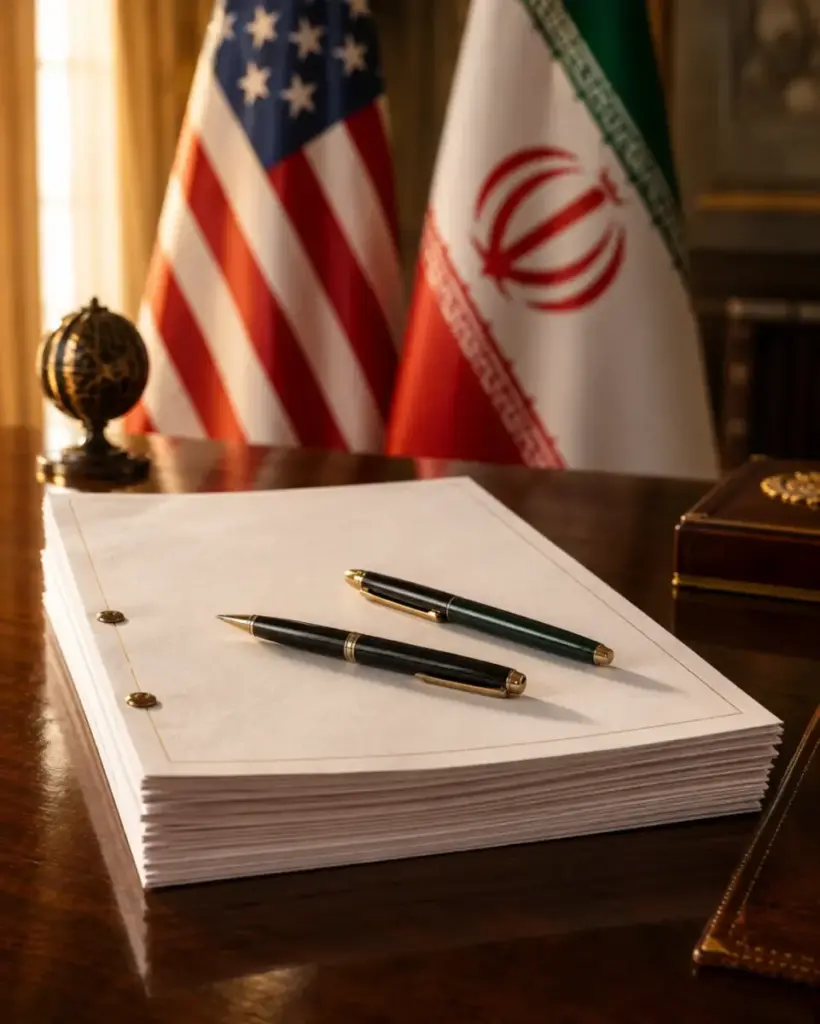
Inside the Peace Deal: What the 14-Page Agreement Actually Says — and What It Means for Gold
Gold rose to $4,325 this Monday June 15 as the world absorbed the historic news: the US and Iran have reached a peace deal to end the nearly four-month war. For gold buyers and investors, understanding the actual terms of the agreement is essential to understanding where the price goes next. Here is what the 14-page memorandum of understanding contains, based on reporting from CNBC, NBC News, and PBS.
The core terms. The agreement establishes the immediate and permanent termination of military operations on all fronts, including in Lebanon. Iranian state media reported a 14-page draft memorandum outlining the deal. It includes a 60-day ceasefire, the lifting of US oil sanctions on Iran, and Iran committing to reopening the Strait of Hormuz. Trump has ordered the immediate removal of the US naval blockade and authorised the toll-free opening of the Strait. The agreement also includes the withdrawal of certain US forces and the release of billions of dollars in frozen Iranian funds — a long-standing Iranian demand.
The Strait of Hormuz provisions. This is the most important element for gold. The Strait — which has been effectively closed since late February, virtually shutting down oil and natural gas shipments from the Persian Gulf — reopens immediately upon the signing for the purpose of mine removal. Oil will flow on both ends again. The de-mining itself will take time: it is unclear how many mines Iran placed in the waterway, and full clearance is committed within 30 days. Today’s G7 summit is discussing the de-mining process, with Britain and France expressing interest in assisting once the conflict has formally ended.
The signing timeline. A formal signing is scheduled for Friday in Switzerland. Iran’s deputy foreign minister said the immediate and permanent end to the war and military operations on various fronts, including Lebanon, would be announced starting from this weekend.
The risks that remain. The deal is not without fragility. It was put at risk earlier in the weekend when Israeli-Hezbollah fighting flared in Lebanon, prompting Israeli strikes in Beirut and condemnation from Trump. Israel is not a party to the deal and its government considers the agreement a deep disappointment. Critics in Trump’s own party have argued it does not improve sufficiently on the 2015 nuclear deal. These tensions mean implementation will be watched carefully.
What it means for gold. The reopening of Hormuz collapses the oil-driven inflation that has suppressed gold for 107 days. Oil fell more than 6% last week and is set to fall further toward $80. Falling oil means falling inflation, a less hawkish Fed, a weaker dollar, and a clear path for gold’s structural tailwinds to drive the price higher. The FOMC meeting tomorrow, June 16–17, under new Chair Warsh, is the next major catalyst. Goldman Sachs targets $5,400 year-end; J.P. Morgan targets $6,300.
Today’s prices: 24K — $139.07/gram | 22K — $127.48/gram | 21K — $121.66/gram
All prices USD. Monday June 15 indicative. Confirm in store.