Nine of Eighteen: Decoding the Fed's Hawkish Shock and What It Really Means for Gold
When the Federal Reserve released its projections on Wednesday June 17, one number jolted the entire market: nine of the eighteen Fed officials now project at least one interest rate hike in 2026. For gold, which fell sharply on the news before recovering, understanding what this number means — and what it does not mean — is essential to navigating the weeks ahead. Gold sits around $4,300 this Friday June 19 as the market continues to digest it.
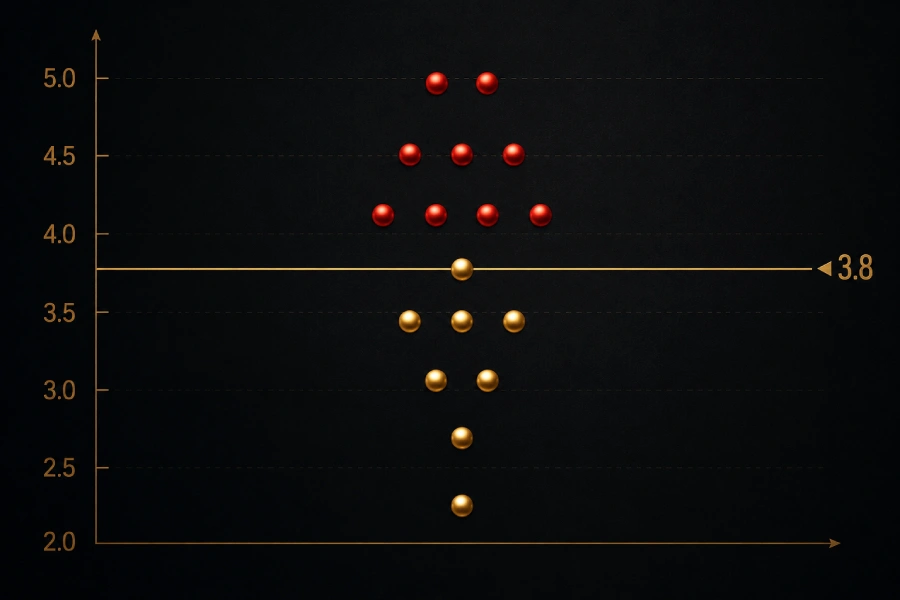
Here is what happened. The Fed held its rate at 3.50% to 3.75%, as expected. But the “dot plot” — the chart of officials’ rate projections — shifted dramatically toward hawkishness. In March, the median Fed official projected a rate cut in 2026. On Wednesday, the median moved to 3.8%, implying a hike, and nine of eighteen officials explicitly projected at least one increase. The Fed also removed its “easing bias” — the language suggesting its next move would be a cut — and new Chair Kevin Warsh stripped out forward guidance entirely, stating the committee “will deliver price stability.” Markets moved to fully price a rate hike by year-end.
Why did this happen? Inflation. May CPI came in at 4.2% — the highest since April 2023 — driven by the energy shock from the Iran war. The Fed is reacting to that high inflation number by signalling it stands ready to raise rates rather than cut them. For gold, higher rates are a headwind, because gold pays no yield and competes with interest-bearing assets. That is why gold fell on Wednesday, dropping toward $4,219 at one point.
But here is what the “nine of eighteen” number does not capture, and why gold recovered above $4,300. The Fed’s projections were made on the basis of Wednesday’s data — data that reflects the high-oil, high-inflation wartime environment. That environment is ending. The peace deal signed this week sent oil tumbling toward $78 per barrel, a three-month low. As oil falls, the 4.2% inflation that justified the hawkish dots will fade over the coming months. One chief economist noted this week that rapidly evolving geopolitical events like the Iran peace deal can quickly render the Fed’s forward guidance outdated. In other words, the hawkish dots may already be behind the curve. The Fed is looking at the inflation the war created; the peace deal is removing the cause of that inflation.
This is the central tension for gold right now. In the short term, the hawkish Fed and stronger dollar pressure the price. In the medium term, falling oil and fading inflation will force the Fed to soften, releasing gold’s structural tailwinds. The beacon’s light points to a recovery, even if the Fed’s hawkishness creates turbulence first.
The structural foundation is unchanged: central banks bought 244 tonnes in Q1 2026, China has accumulated for 17 months, and every major bank’s year-end target — Goldman Sachs $5,400, J.P. Morgan near $6,000 — sits well above today’s $4,300.
Today’s prices: 24K — $137.52/gram | 22K — $126.06/gram | 21K — $120.31/gram
All prices USD. Friday June 19 indicative. US markets closed for Juneteenth. Confirm in store.