Safe-Haven vs. Rate Risk: The Two Forces Fighting Over Gold Before Next Week’s Fed
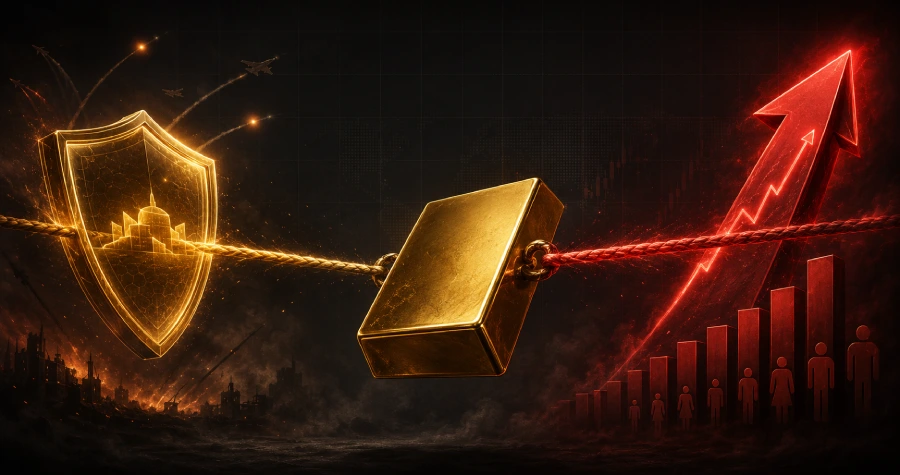
Gold fell about 2% on Thursday July 24 to around $4,050 per ounce, retreating from a two-week high — and the move perfectly captured the central battle now defining the gold market. Two powerful forces are fighting over gold’s direction: safe-haven demand from the Middle East war, which pulls it up, and rate-hike risk from a strong US economy, which pushes it down. Understanding this battle is the key to reading gold as next week’s crucial Federal Reserve meeting approaches.
On the safe-haven side, the case for gold is real. The US-Iran war continues, with talks in Qatar awaited but no direct negotiations expected, and ongoing disruption to Hormuz and Red Sea shipping lanes from Houthi threats. This geopolitical risk generates genuine demand for gold as a store of value in uncertain times, and it has cushioned gold’s declines throughout the week. Earlier in the week, hopes of a diplomatic opening actually lifted gold to its two-week high.
On the rate-risk side, the pressure intensified sharply on Thursday. US jobless claims fell to 187,000 — the lowest in 57 years — revealing an exceptionally strong labor market. A robust economy gives the Federal Reserve room to keep interest rates high rather than cutting them, especially with oil elevated near $97 a barrel and inflation a concern. The European Central Bank held its rates steady, Treasury yields stayed firm near 4.70%, and the dollar remained strong near 101.39. Because gold pays no yield, all of this raises the opportunity cost of holding it. As analysts observed, market positioning turned “less dovish” than the softer June inflation data had implied.
On Thursday, the rate-risk force won, and gold fell below $4,100. But the safe-haven force kept the decline orderly rather than allowing a rout. This is the balance the market now sits in, and it explains why gold has been swinging within a range — up on war and diplomacy headlines, down on strong data and firm yields.
The decisive moment comes next week at the Federal Reserve’s meeting on July 28–29. The Fed is widely expected to hold interest rates steady. But the real question is the one that will tip the balance between these two forces: how does Chair Kevin Warsh characterise the situation? If he treats the elevated oil prices and strong labor market as reasons to keep policy tight — a hawkish stance — the rate-risk force strengthens and gold could test lower toward the $3,998 support area. If he signals that the Fed can look past the oil shock and the strong data — a more dovish stance — the safe-haven force gains the upper hand and gold could recover toward resistance at $4,139.
For buyers, the beacon’s light shows a market in genuine balance. Gold near $4,050 is about 27% below January’s record of $5,597 and up roughly 20% over the past year. The structural floor is firm: central banks bought a net 41 tonnes in May, and a record 45% plan to buy more this year — a long-duration bid that persists regardless of rate expectations. Next week’s Fed decision, along with US Q2 GDP and PCE data, will determine which force prevails.
Today’s prices: 24K — $130.20/gram | 22K — $119.35/gram | 21K — $113.95/gram
All prices USD. Thursday July 24 indicative. Volatile market. Confirm in store.