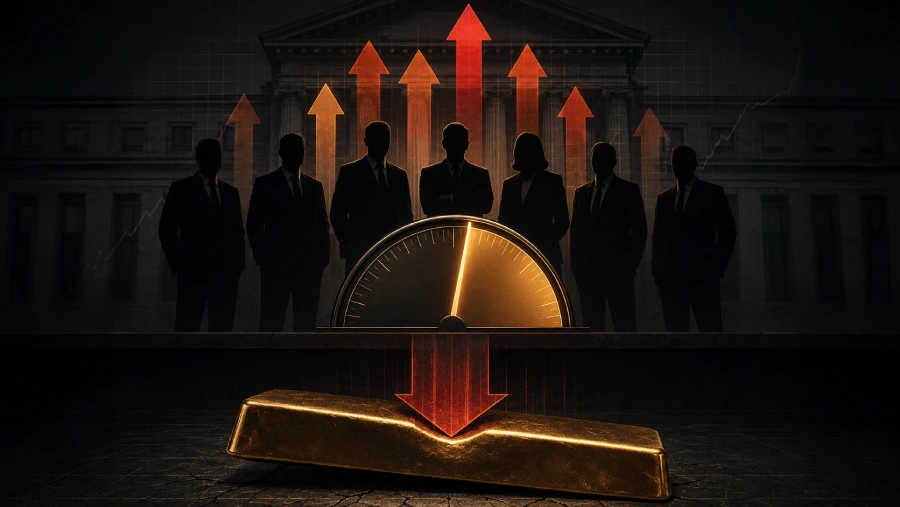
The Fed Is Turning Hawkish as War Rages: Why Multiple Officials Now Want a Rate Hike
Gold has slipped below $4,000 per ounce this Monday July 20, and the reason lies not only in the escalating war but in a significant shift happening inside the Federal Reserve. Over the past few days, multiple Fed officials have begun openly calling for or leaning toward an interest rate hike — a meaningful change that is reshaping the outlook for gold. Understanding this shift is the key to reading where gold goes next.
Here is what has changed. For weeks, the market debated whether the Fed would hike rates in September, with the odds hovering near 50%. Then the war escalated. As the US-Iran conflict entered its tenth day, with oil surging about 30% from its July lows and Brent climbing above $90 a barrel, Fed officials grew visibly more concerned about inflation. Dallas Fed President Lorie Logan became the first of new Chair Kevin Warsh’s colleagues to publicly call for a rate hike. Cleveland Fed President Beth Hammack warned about persistent inflation. And Fed Vice Chair Philip Jefferson said he would support tighter policy if inflation does not improve in the near term. This chorus of hawkish voices pushed the probability of a September rate hike up to about 53%, from 47% just a day earlier.
Why does this matter so much for gold? Because gold pays no yield, its price is extraordinarily sensitive to interest rate expectations. When Fed officials signal they are ready to hike, the dollar strengthens and the opportunity cost of holding non-yielding gold rises — both of which push gold down. The war’s real effect on gold runs through exactly this channel: the conflict drives oil up, oil drives inflation up, and inflation drives the Fed toward hiking. This weekend’s escalation made that chain more concrete, and gold fell below $4,000 as a result.
The next major signal is the Fed’s meeting on July 29, now nine days away. The Fed is still widely expected to hold rates steady at that meeting. But the rising number of officials calling for a hike has increased the risk that the Fed’s tone — or its actual decision — surprises on the hawkish side. Chair Warsh’s words will be scrutinized closely. A hawkish message would pressure gold toward the $3,959 support level, then $3,900. A more balanced tone, suggesting the oil-driven inflation is temporary and war-related, could allow gold to stabilize.
For buyers, the beacon’s light shows a market under pressure but with a deep discount. Gold below $4,000 is roughly 28% under January’s record of $5,597, yet still up around 18% over the past year. The structural floor holds firm: China’s central bank has been buying at its fastest pace in more than two and a half years. And the crucial insight remains — the same war driving the hawkish Fed is the thing whose resolution would reverse everything. If the conflict ends, oil falls, inflation eases, the hawkish officials reverse course, and gold rallies. Today’s hawkish shift is real, but it is tied to a war that will not last forever.
Today’s prices: 24K — $128.55/gram | 22K — $117.85/gram | 21K — $112.45/gram
All prices USD. Monday July 20 indicative. Volatile market. Confirm in store.