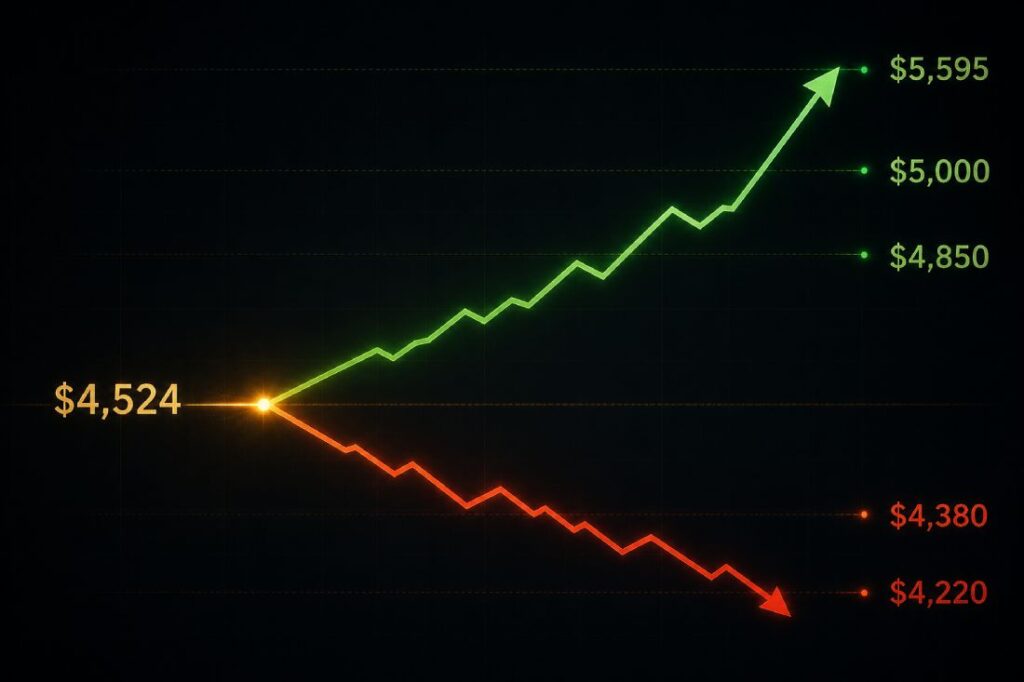
Gold is at $4,524 this Friday May 22. The news this week has been the most complex mix of contradictions the market has faced in months — Trump saying talks are in the "final stages" while Iran's Supreme Leader simultaneously orders enriched uranium to stay in Iran; Fed officials discussing rate hike thresholds while oil jumps back above $106; PMI and Michigan inflation data arriving today that will either firm or soften the rate outlook. Rather than a single narrative, this week demands a two-scenario analysis. Here is each path clearly mapped.
Scenario A: The Deal Happens — Gold Goes to $4,850 and Beyond Within Weeks
If the uranium dispute is resolved — perhaps through a face-saving arrangement where Iran's enriched uranium is stored under international monitoring inside Iran rather than shipped abroad — and a comprehensive Hormuz reopening is agreed, the chain reaction is powerful and fast. Oil falls from $106 toward $80 to $85. Headline CPI for May and June drops sharply. The Fed's rate hike discussion becomes immediately irrelevant — you cannot credibly hike into a collapsing inflation reading. Rate cut expectations return, possibly pricing in two cuts before year-end. The dollar softens. Gold surges. Technical analysts identify $4,850 as the first major resistance, then $5,000, then the previous high of $5,595. Goldman Sachs's $5,400 year-end target becomes not optimistic but conservative. Timeline: if a deal is announced this month or in early June, gold could be back above $5,000 within 30 days.
Scenario B: The Deal Fails — Gold Tests $4,380 to $4,220
If the uranium impasse holds and Trump follows through on his "nasty things" warning — resuming targeted strikes on Iranian infrastructure — oil spikes above $120 per barrel. Inflation expectations jump further. The Fed moves closer to a hike. The dollar surges. In this scenario gold faces the same paradox it has since February: the war makes it a safe haven but the oil shock suppresses it via inflation mechanics. The key technical support levels are $4,490 then $4,380 then the 200-day moving average at $4,328 and the next major support at $4,220. This scenario is painful for short-term holders but creates the deepest discount buying opportunity since the bull run began in 2024.
Where we sit today: Trump's "final stages" language and China's backing away from Iran (the Beijing summit outcome) suggest Scenario A is still possible. The Supreme Leader's uranium directive suggests the timeline for Scenario A has extended. The probability distribution has shifted toward "deal later" rather than "deal never" — but later could mean June or it could mean August or September.
The beacon watches both paths. At $4,524, buyers who are building positions over time are covered in either scenario with a long enough horizon.