Oil at War-Time Lows While War Rages: The Strange Signal Driving Gold Today
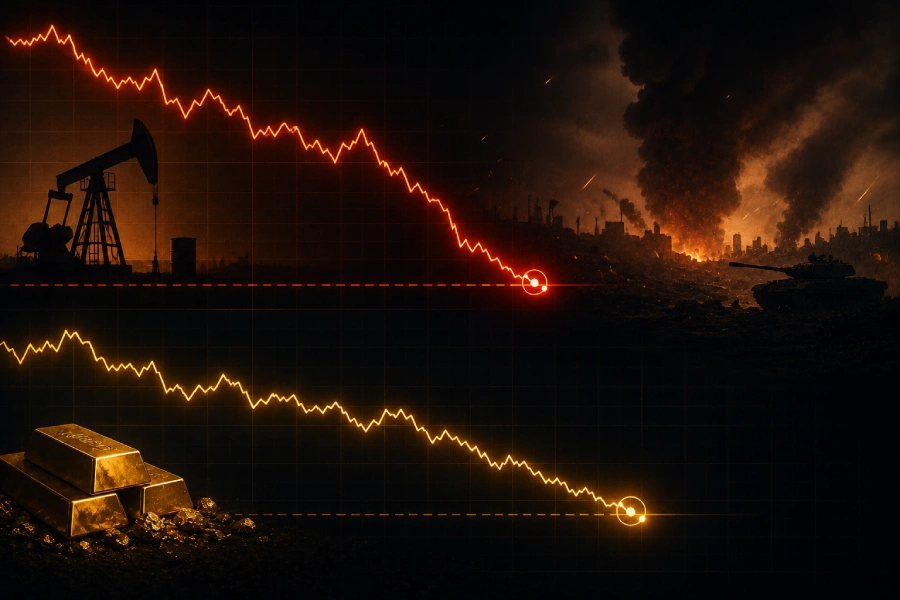
There is a signal in the markets this Monday June 29 that, once understood, explains the entire strange behaviour of gold right now. The Gulf is at war — Iran struck US bases in Kuwait and Bahrain over the weekend — and yet oil prices have fallen to their lowest level since the conflict began, with Brent around $72 and US crude around $70. War with falling oil is highly unusual, and this single signal is the key to understanding why gold is sitting near $4,015, down about 1.7% today, rather than soaring on the conflict.
Let us decode it. Normally, conflict in the Gulf — home to the Strait of Hormuz, through which 20% of the world’s oil flowed before the war — sends oil prices sharply higher on fears of supply disruption. Higher oil drives inflation, and historically that has supported gold as an inflation hedge. But this weekend, despite Iran striking US bases and hitting ships in the strait, oil fell rather than rose. Why?
The answer lies in what the market now believes about Hormuz. Even amid the violence, Iran’s foreign minister Abbas Araghchi stated that the Strait of Hormuz will return to pre-war capacity within 30 days under Iranian management. The market is reading the weekend’s escalation not as a permanent return to war, but as last-minute friction in a negotiation that is still heading toward a deal — with both sides agreeing to resume talks in Doha tomorrow, June 30. Because the market expects Hormuz to reopen and oil to flow, it is pricing oil for peace even as missiles fly. Falling oil means falling inflation expectations.
And here is how that drives gold. Falling inflation expectations reinforce the market’s focus on the one thing dominating gold in 2026: the Federal Reserve. With inflation expected to ease as oil falls and Hormuz reopens, and with the Fed under new Chair Warsh firmly committed to fighting inflation, markets are pricing roughly three rate hikes this year, with about a 60% chance of the first in September. High rates are gold’s primary enemy, because gold yields no income. So the chain runs: war, but expected Hormuz reopening, leading to falling oil, leading to falling inflation expectations, leading to a still-hawkish Fed focus, leading to a strong dollar, leading to lower gold. The war is real, but the market is looking past it to a reopened strait and a hawkish Fed.
For buyers, this signal carries an important message. The forces pushing gold down are tied to expectations of peace and a hawkish Fed — both of which could
shift quickly. If the Doha talks collapse and the war genuinely re-escalates, oil
could spike, inflation fears could return, and gold’s safe-haven role could reassert itself rapidly. And the structural floor remains firm regardless: global bar-and-coin demand hit 474 tonnes in Q1 2026, up 42% year-over-year, and roughly 90% of central banks expect to increase reserves over the next year. Gold near
$4,015 is down 10.5% this month but still up 21.6% over the year. This week’s US jobs report and ISM Manufacturing data will be the next signals to watch.
Today’s prices: 24K — $129.50/gram | 22K — $118.70/gram | 21K —
$113.30/gram
All prices USD. Monday June 29 indicative. Confirm in store.