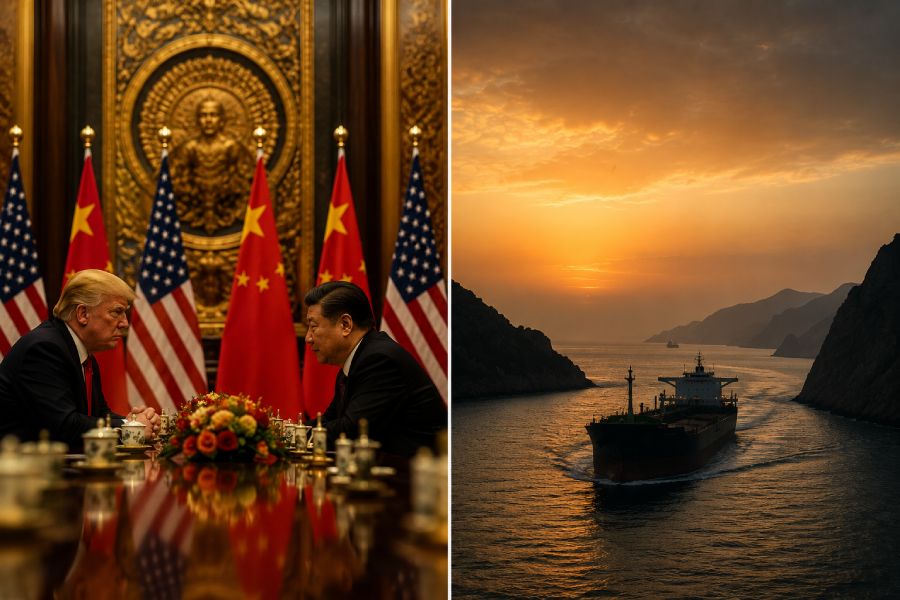
Gold is at $4,686 per ounce this Thursday morning, and the price action for the rest of this week will be decided not in Washington, not in Tehran, but in Beijing — where President Trump arrived last night for a summit with Xi Jinping that markets are watching more closely than any diplomatic event since the ceasefire was declared on April 8.
Trump landed at Beijing Capital International Airport at 7:50 PM local time Wednesday. Three hundred Chinese children in blue and white uniforms waved American and Chinese flags on the tarmac. He was greeted by Chinese Vice President Han Zheng — Xi's chosen envoy for state arrivals. The delegation includes more than a dozen major US corporate executives including Apple's Tim Cook and Elon Musk. The stated agenda covers trade, Taiwan, AI oversight, and nuclear treaties. The real agenda has one word at the top: Iran.
Here is why China is the key to the Hormuz deadlock. Iran's foreign minister Abbas Araghchi visited Beijing just days before Trump arrived. China is Iran's largest oil customer — it has been quietly purchasing Iranian crude throughout the war, providing Tehran's economy with the oxygen it needs to sustain the conflict. China was also credited with helping push Iran to accept the original April 8 ceasefire. And China has a powerful self-interest in ending the war: elevated oil prices hurt Chinese manufacturing, and the supply chain disruptions from the Hormuz closure are beginning to bite Chinese industry.
The geopolitical analysis is clear. Xi holds cards that Trump needs: leverage over Iran that no American or Western pressure can match. But Xi also has his own price — on Taiwan, on trade, on rare earth minerals that the US now needs to replenish its depleted missile interceptor stocks. As one analyst from the International Crisis Group told NPR: "The war in Iran has given President Xi sources of leverage that he would not have anticipated having at the beginning of this year."
For gold, the summit has a binary outcome. If Trump and Xi produce any joint language on Iran — a framework for China to actively pressure Tehran toward Hormuz reopening — oil falls, inflation expectations collapse, rate hike fear recedes, and gold recovers sharply from $4,686 toward $4,800 and higher. If the summit produces trade deals but nothing on Iran, gold stays under pressure and may test $4,650 or lower.
The beacon watches Beijing today.